
Gottman Method Insights
Gottman Method Insights: Helping Partners Feel Heard, Navigate Differences, and Build a Life Together That Feels Supportive and Fun
Most couples do not come to therapy because they do not love each other.
They come because they feel unheard, misunderstood, or stuck having the same conversations over and over again.
Research backs this up. Communication problems are consistently one of the top reasons couples report relationship dissatisfaction, even when commitment and affection are still present. According to the Gottman Institute, it is not conflict itself that predicts relationship failure, but how couples manage it.
This distinction matters. Many couples assume that a healthy relationship should feel easy or conflict-free. When it does not, they conclude something is wrong with them or their partner. In reality, long-term relationships naturally involve differences in personality, needs, values, and stress responses.
What determines whether those differences bring people closer or push them apart is how partners respond to each other emotionally.
That is where the Gottman Method offers clarity. Built on over 40 years of research with thousands of couples, the Gottman Method provides practical, evidence-based strategies to help partners feel heard, understood, and emotionally connected, even when they disagree.
Many of these ideas align with themes explored in How to Improve Communication in Your Relationship, where emotional safety and responsiveness are identified as key drivers of connection. The Gottman Method goes a step further by showing why those elements matter and how to build them intentionally.
In this post, we will explore how Gottman insights support couples in navigating differences, strengthening emotional connection, and building a shared life that feels both supportive and genuinely enjoyable.
1. What the Gottman Method Is and Why It Works
The Gottman Method is not based on opinion or theory alone.
It is based on direct observation and measurable outcomes.
Drs. John and Julie Gottman studied couples over decades, tracking communication patterns, emotional responses, and physiological data to identify what actually predicts relationship success or breakdown. Their research became so precise that they could predict divorce with over 90 percent accuracy based on specific interaction patterns.
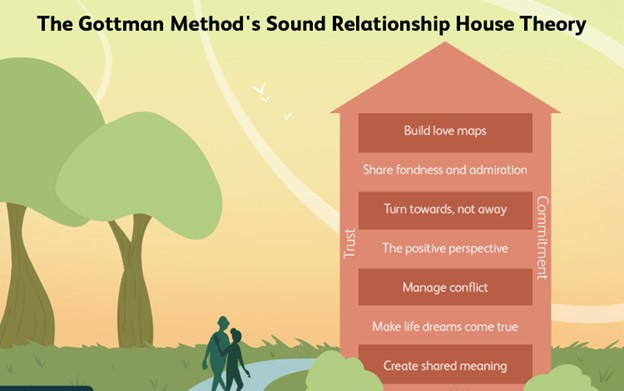
From this work came the Sound Relationship House Theory, a framework that explains how healthy relationships are built layer by layer. These layers include:
- building detailed knowledge of each other’s inner world
- expressing fondness and admiration
- responding positively to bids for connection
- managing conflict rather than trying to eliminate it
- creating shared meaning and purpose
This structure is important because it reframes relationship health as something built through daily behaviours, not fixed personality traits or “chemistry”. Relationships succeed not because partners never struggle, but because they repeatedly choose connection during ordinary moments.
One of the most well known findings from Gottman research is the 5 to 1 ratio. Stable, happy relationships tend to have at least five positive interactions for every negative one, even during conflict.
That ratio does not mean avoiding hard conversations. It means that warmth, appreciation, humour, and responsiveness consistently outweigh criticism, defensiveness, or withdrawal.
This insight connects closely to what many couples experience in practice. When stress is high and positive interactions drop, even small issues can feel overwhelming. This pattern is also reflected in Why Resilience Begins with Openness, where openness and emotional responsiveness are described as foundations for resilience, not luxuries.
Another key Gottman insight is that most conflict is perpetual. Research suggests that roughly 69 percent of relationship conflicts stem from ongoing differences in personality, values, or lifestyle rather than solvable problems.
This means the goal of a healthy relationship is not to eliminate disagreement. It is to learn how to talk about differences without damaging trust or emotional safety.
Understanding this alone can be relieving. It shifts couples away from the belief that something is “wrong” because an issue keeps resurfacing. Instead, it opens the door to learning how to stay connected while navigating difference, a theme that shows up across many relational challenges, including parenting dynamics discussed in Managing Different Parenting Styles: How to Stay Connected While Raising Kids Together.
In the next section, we will focus on one of the most central Gottman goals: helping partners feel genuinely heard and understood, especially during difficult conversations.

2. Navigating Differences Without Trying to Win
One of the most helpful insights from the Gottman Institute is also one of the most relieving for couples to hear: most conflict in long-term relationships is not meant to be solved.
Research from the Gottman Institute shows that the majority of recurring arguments fall into what they call perpetual problems, differences rooted in personality, values, needs, or life experiences. These might include disagreements about money, intimacy, parenting styles, or how much structure versus flexibility each person needs. The issue itself may never disappear, but the way couples relate to it can change dramatically.
Problems arise when partners treat these differences as something to defeat. When the goal becomes winning, conversations quickly shift toward defensiveness, persuasion, or shutting down. Over time, this creates distance rather than resolution.
Healthier couples approach differences with curiosity instead of control. They focus less on proving a point and more on understanding what the issue represents for the other person. That shift alone reduces emotional intensity and keeps conversations from escalating.
This does not mean ignoring needs or avoiding hard conversations. It means replacing power struggles with collaboration. Instead of asking, “How do I get my partner to change?” the more effective question becomes, “How do we make space for both of our needs to exist?”
When couples learn to tolerate differences without seeing them as threats, conflict becomes less personal and more manageable. The relationship stops feeling like a battleground and starts feeling like a partnership again.

3. Turning Toward Instead of Away During Conflict
One of the strongest predictors of relationship stability has nothing to do with how often couples fight. It has to do with what they do in the small moments when tension shows up.
Gottman’s research highlights the importance of turning toward rather than turning away during moments of stress, frustration, or disconnection. Turning toward does not mean fixing the problem or having the perfect response. It means staying emotionally present instead of withdrawing, dismissing, or escalating.
In conflict, many couples unknowingly turn away through behaviours like shutting down, changing the subject, becoming sarcastic, or focusing on being right. Others turn against each other by criticising, becoming defensive, or responding with contempt. These patterns don’t usually come from malice. They are often automatic responses to feeling overwhelmed or unheard.
Turning toward looks much simpler. It can sound like pausing the argument to acknowledge emotion, making a repair attempt, or expressing willingness to come back to the conversation later when both partners are calmer. Small gestures, humour, reassurance, or even naming the tension, often do more to restore connection than long explanations ever could.
This is especially important during conflict because emotional arousal makes clear communication harder. When partners prioritise staying connected over winning the argument, the nervous system begins to settle, and problem-solving becomes possible again.
Couples who practice turning toward build trust not by avoiding conflict, but by showing that connection matters even when things are hard. Over time, this creates a relationship where disagreements feel safer and less threatening, because both partners know they are not alone in them.

4. Building a Relationship That Feels Supportive, Not Draining
A supportive relationship does more than feel good. It actively protects emotional and mental health. When partners experience their relationship as emotionally safe, they are better able to manage stress from work, parenting, and daily responsibilities.
Decades of research from the Gottman Institute show that emotionally responsive partnerships act as a buffer against stress. Their research on emotional attunement and trust demonstrates that when partners feel understood and supported, they show greater resilience during difficult life periods.
Support does not mean fixing everything. One of the most common breakdowns couples experience happens when one partner wants empathy and the other jumps straight into problem-solving. Gottman research consistently shows that validation and emotional responsiveness matter more than advice in moments of stress.
A relationship starts to feel draining when emotional needs go unmet or conversations feel unsafe. Over time, this can create chronic tension that spills into other areas of life.
When couples learn how to respond supportively, the relationship becomes a place to recover from stress, not another source of it. Many of the communication and regulation skills discussed in our relationship therapy blog resources are designed to help couples build this sense of emotional safety in everyday interactions.

5. Making Space for Fun, Friendship, and Shared Meaning
One of the most overlooked findings in relationship research is how much friendship and enjoyment matter. Long-term couples do not stay connected because they solve every problem. They stay connected because they genuinely like each other.
Research from the Gottman Institute shows that strong relationships are built on a foundation of friendship, shared affection, and positive interactions. Couples who maintain friendship and fun are more resilient during conflict and recover more quickly after disagreements.
Fun does not require constant date nights or elaborate plans. It grows through small, repeated moments like shared humour, everyday appreciation, inside jokes, and simple rituals that reinforce connection. Over time, these positive interactions shape how partners experience one another. When goodwill is built consistently, partners are more likely to interpret each other’s behaviour generously rather than critically, especially during moments of stress or disagreement.
Shared meaning adds another layer of connection. Couples who feel they are building a life together often share values, traditions, or goals that give their relationship a sense of purpose. This sense of shared direction helps relationships stay grounded during transitions, uncertainty, and change. When partners feel connected to something larger than the day-to-day logistics of life, challenges become easier to navigate and conflict feels less threatening.
When friendship and meaning fade, conflict tends to feel heavier. Rebuilding connection is often not about addressing the conflict directly, but about restoring emotional closeness. Many couples explore this process further through guided relationship support, especially when disconnection has been present for a long time.
6. When Gottman Insights Need to Be Adapted
While Gottman-based tools are strongly supported by research, they are not meant to be applied rigidly. Real relationships are shaped by nervous system responses, past experiences, trauma histories, and individual differences in emotional regulation.
Neuroscience research shows that heightened emotional arousal can impair communication, working memory, and decision-making during conflict. Under stress, the brain shifts resources away from reflection and toward survival, making it harder to listen or respond thoughtfully. This process is well documented in research on stress and prefrontal cortex functioning.
For some couples, emotional flooding, shutdown, or reactivity makes it unrealistic to simply “use the skills” without support. In therapy, Gottman-informed strategies are often slowed down and adapted so couples can practise them in ways that feel safe and achievable.
Adaptation also includes recognising when the goal is not improved communication but healthier boundaries. Large-scale research shows that ongoing exposure to invalidating or harmful relational environments increases stress and emotional dysregulation over time. In these cases, reducing exposure and setting limits is protective, not avoidant, as demonstrated in population-level relationship stress research.
Effective relationship work respects both connection and protection. When Gottman insights are applied flexibly and thoughtfully, they support safety, understanding, and long-term resilience rather than pressure to communicate perfectly.

Conclusion: Strong Relationships Are Built, Not Found
Strong relationships are not defined by the absence of conflict. They are shaped by how partners respond to moments of difference, stress, and disconnection over time.
Research from the Gottman Institute consistently shows that lasting connection is built through emotional safety, responsiveness, and repair, not perfection. When couples learn to navigate differences without trying to win, stay emotionally present during conflict, and intentionally protect friendship and fun, relationships become more resilient.
At the same time, no method works in isolation. Real relationships are influenced by nervous system responses, personal histories, and the realities of daily life. Growth happens not through flawless communication, but through practice, patience, and support.
Building a relationship that feels supportive, secure, and enjoyable is a skill set that can be learned and strengthened over time.
How Sigpark Counselling Can Help
At Sigpark Counselling, we help couples apply Gottman-based insights in a way that fits their real lives. Therapy is not about assigning blame or following rigid rules. It is about slowing conversations down, increasing emotional safety, and helping partners practise skills that actually work under stress.
Our couples therapy approach is tailored to each relationship and informed by both research and lived experience. We support partners in strengthening communication, navigating ongoing differences, and rebuilding connection when things feel strained or stuck. You can explore more about our approach through our relationship therapy resources.
If you are ready to move toward a relationship that feels more connected, supportive, and even fun again, we invite you to reach out.
Book a consultation with Sigpark Counselling to explore how couples therapy can support your next steps.