
What Is DBT and How Does It Help with Stress, Relationships, and Emotional Overwhelm
Many people come to therapy with a strong sense of insight. They understand why they react the way they do. They know where their patterns come from. They’ve read the books, listened to the podcasts, and reflected deeply.
And yet, in the moment, during conflict, overwhelm, or stress, that insight can disappear.
Emotions take over. The nervous system reacts. Old patterns return.
This is where skills-based approaches like Dialectical Behaviour Therapy, or DBT, become especially helpful.
DBT doesn’t replace insight. It supports it. It offers practical tools for moments when stress is high and thinking clearly feels difficult. Rather than asking people to change how they feel, DBT focuses on helping them respond more effectively when emotions are intense.
In this article, we’ll explore what DBT is, how it works, and why it’s often used to support people dealing with emotional overwhelm, relationship challenges, burnout, and chronic stress. We’ll also look at how DBT skills are applied in therapy in a flexible, client-centred way. For additional reflections on emotional regulation and therapy approaches, you can explore related posts on the Sigpark Counselling blog.
What Is DBT?
Dialectical Behaviour Therapy, commonly referred to as DBT, is a therapeutic approach that focuses on building skills for managing emotions, navigating relationships, and tolerating distress more effectively.
DBT was originally developed by psychologist Marsha Linehan to support individuals experiencing intense emotional dysregulation. Over time, its use has expanded well beyond its original context. Today, DBT skills are widely used to support people dealing with anxiety, stress, burnout, relationship conflict, and difficulty managing emotions under pressure.
At its core, DBT is built on a simple but powerful idea: two things can be true at the same time.
You can be doing your best and still struggle.
You can accept yourself and want change.
You can feel overwhelmed and learn skills to cope more effectively.
This “both-and” approach helps reduce the shame and self-criticism that often come with emotional struggles. Instead of framing challenges as failures, DBT treats them as experiences that can be worked with skillfully.
According to the National Institute of Health, DBT combines acceptance-based strategies with change-focused skills, making it especially effective for helping people regulate emotions and improve coping responses.
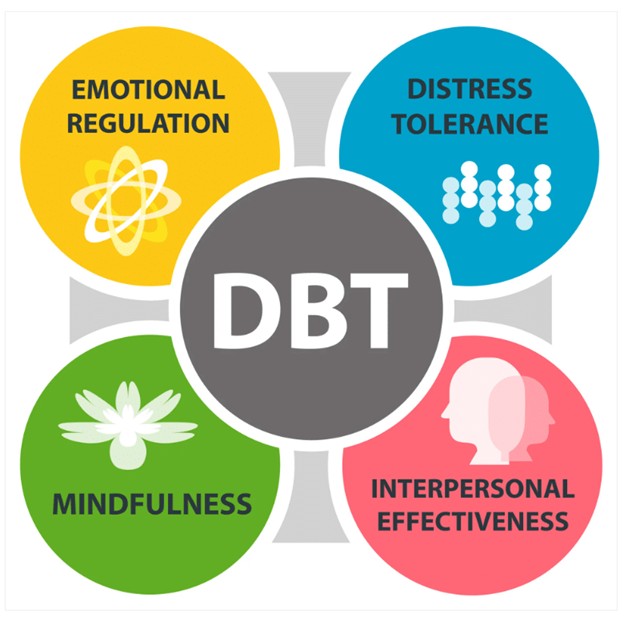
DBT is typically taught through four main skill areas:
- Mindfulness
- Distress tolerance
- Emotion regulation
- Interpersonal effectiveness
These skills are not about suppressing emotions or “thinking positively.” They’re about helping the nervous system stay regulated enough for choice, communication, and problem-solving to remain accessible.
In therapy, DBT skills are often adapted to each person’s needs rather than applied rigidly. Many therapists integrate DBT tools alongside other approaches to support emotional regulation and relational balance.
The Core DBT Principle: “Both Things Can Be True”
At the heart of DBT is a simple but powerful idea: two things can be true at the same time.
You can accept yourself as you are and want things to change.
You can feel overwhelmed and still take small, skillful steps forward.
You can be doing your best and need more support.
This idea, known as dialectics, helps loosen the rigid thinking patterns that often show up during stress, burnout, or relationship conflict. When the nervous system is under pressure, thinking tends to become black-and-white. Situations feel urgent. Options feel limited. Mistakes feel catastrophic.
Dialectical thinking creates space.
Instead of framing experiences as success or failure, DBT encourages curiosity. Instead of asking “What’s wrong with me?”, it invites the question, “What’s happening right now, and what would help?”
This shift is especially helpful for people who struggle with perfectionism or self-criticism. When expectations are rigid, internal pressure increases. When pressure increases, regulation decreases.
The idea of flexibility and openness as a foundation for resilience is explored further in Sigpark Counselling’s blog post “Why Resilience Begins with Openness.” That post looks at how moving away from rigid coping strategies supports emotional regulation and long-term change, a principle that closely aligns with DBT’s dialectical approach.
In therapy, learning to hold two truths at once often reduces shame. It allows people to acknowledge real pain without being defined by it. That balance, acceptance without resignation, is what makes change sustainable.

DBT and Emotional Regulation: Staying Grounded Under Stress
Emotional regulation is often misunderstood as controlling or suppressing feelings. DBT approaches regulation differently.
Rather than trying to eliminate emotions, DBT focuses on helping people stay present and grounded when emotions are strong, so they can respond instead of react.
When stress rises, the nervous system can move quickly into fight, flight, freeze, or shutdown. Thinking narrows. Emotional intensity increases. Access to coping strategies decreases.
DBT skills are designed to intervene early, before overwhelm takes over completely.
This might look like:
- Noticing emotional escalation sooner
- Using grounding or distress tolerance skills to prevent shutdown
- Naming emotions instead of being consumed by them
- Creating enough regulation to make thoughtful choices
These skills are especially useful during periods of chronic stress, such as academic pressure, work overload, or ongoing relational tension. When stress is constant, regulation becomes harder, not because someone lacks discipline, but because the nervous system is depleted.
This connection between stress, overwhelm, and the need for realistic, accessible tools is explored in Sigpark Counselling’s blog “Why Students Need Fast, Realistic Tools During Finals.” While written with students in mind, the core ideas apply broadly to anyone navigating high-pressure environments. The post highlights how practical strategies can support emotional regulation when capacity is low.
In therapy, DBT skills are practiced gradually and adapted to real-life situations. The goal isn’t perfect regulation; it’s increased capacity. Over time, this helps people stay more grounded during stress, communicate more effectively, and recover more quickly when emotions run high. For more reflections on emotional regulation and stress responses, you can explore additional resources on the Sigpark Counselling blog.

DBT Skills for Work Stress and Burnout
Work stress and burnout are rarely the result of poor time management or a lack of motivation. More often, they happen when emotional and nervous system capacity is exceeded for too long.
DBT approaches burnout by focusing on what helps the system get through high-pressure moments without making things worse.
Rather than encouraging people to push harder or power through, DBT introduces distress tolerance skills, tools designed for moments when stress is already high, and relief isn’t immediately possible. These skills don’t fix the situation, but they prevent escalation.
In practical terms, DBT helps people:
- Get through demanding days without emotional shutdown
- Reduce reactivity when stress is unavoidable
- Recover more quickly after periods of high output
- Interrupt the cycle of pressure followed by collapse
This is especially important in work environments where expectations are constant and rest feels conditional. When stress never turns off, the nervous system doesn’t get the signal that it’s safe to stand down.
The need for realistic, accessible tools during high-pressure periods is something Sigpark Counselling explores in the blog post “Why Students Need Fast, Realistic Tools During Finals.” While the context is academic, the underlying principle applies directly to work burnout: when capacity is low, tools need to be simple, grounding, and immediately usable.
In therapy, DBT skills are practiced in ways that fit each person’s real-life demands. The focus isn’t on eliminating stress, but on helping the nervous system stay regulated enough to prevent burnout from deepening.
Over time, people often notice they can tolerate stress without becoming consumed by it, and that alone can change their relationship with work.

DBT and Perfectionism: Moving Beyond All-or-Nothing Thinking
Perfectionism often thrives in environments where mistakes feel costly and self-worth feels conditional. Under stress, thinking tends to narrow, and perfectionism becomes a way to regain control.
DBT addresses perfectionism by targeting black-and-white thinking, the internal rule that things must be done perfectly or not at all.
Instead of challenging perfectionism head-on, DBT introduces flexibility.
This might look like:
- Recognizing when “good enough” is actually sufficient
- Noticing self-criticism without immediately reacting to it
- Tolerating discomfort when things are unfinished or imperfect
- Choosing effectiveness over perfection
These shifts are subtle, but powerful. They reduce internal pressure without asking people to abandon standards or values.
The idea that emotional resilience grows through openness rather than rigidity is explored further in Sigpark Counselling’s blog “Why Resilience Begins with Openness.” That post speaks to how loosening rigid internal rules creates more room for regulation, adaptability, and self-compassion, all core goals of DBT-informed work.
In therapy, DBT helps clients practice responding to perfectionistic urges with awareness rather than obedience. Over time, this builds trust in the ability to cope even when things aren’t ideal.
Instead of relying on perfectionism to feel safe, people begin to develop internal stability, a sense that mistakes, uncertainty, and imperfection are tolerable.
That shift doesn’t happen overnight, but it becomes possible when skills are practiced in a supportive, non-judgmental space.

DBT in Relationships: Communication Without Power Struggles
Relationship conflict often isn’t about communication skills alone. It’s about what happens when emotions escalate, and the nervous system goes into protection mode.
Under stress, people tend to move toward familiar survival strategies. Some push harder, explain more, or try to regain control. Others withdraw, shut down, or avoid conflict altogether. Over time, these patterns can turn into power struggles, resentment, or emotional distance, even when both people care deeply about the relationship.
DBT’s interpersonal effectiveness skills are designed to support communication without sacrificing safety or self-respect.
Rather than focusing on saying the “right” thing, DBT helps people:
- Recognize when emotions are driving the interaction
- Slow down reactive responses
- Ask for needs clearly and respectfully
- Set boundaries without guilt or defensiveness
These skills are especially helpful when relationships feel imbalanced, when one person is carrying more emotional labour, responsibility, or regulation than the other.
DBT doesn’t aim to eliminate conflict. It helps people stay regulated enough to remain present during conflict, so conversations don’t escalate into power struggles or shutdown.
In therapy, DBT-informed relationship work often focuses less on assigning fault and more on helping each person understand how stress responses shape their interactions. When safety increases, collaboration becomes possible again.

Compassion as a Skill, Not a Personality Trait
Compassion is often misunderstood as something you either have or don’t. In DBT, compassion is treated very differently, as a skill that can be practiced, especially when stress is high.
From a nervous system perspective, compassion signals safety. When internal or external messaging is harsh, critical, or demanding, the body interprets that tone as a threat. Stress responses stay active. Emotional capacity shrinks.
DBT teaches compassion through validation, first toward oneself, and then toward others.
Validation doesn’t mean agreeing with everything you think or feel. It means acknowledging your experience without judgment. This small shift can dramatically reduce emotional intensity.
Practicing compassion as a skill helps people:
- Notice patterns without immediately criticizing themselves
- Recover more quickly after emotional stress
- Reduce shame-driven reactions
- Stay engaged rather than shutting down
This is especially important for people navigating perfectionism, burnout, or relationship conflict. In those contexts, self-criticism often fuels the very patterns someone is trying to change.
In therapy, compassion is practiced in real time. Clients learn to recognize when self-criticism is driving stress and experiment with responding differently, at a pace that feels manageable.
Compassion isn’t the end goal of DBT. It’s the foundation that allows other skills, communication, regulation, and boundary-setting, to work.
How DBT Is Used in Therapy (Not as a One-Size-Fits-All Approach)
DBT is often misunderstood as a rigid or highly structured form of therapy. In practice, DBT is most effective when it’s used flexibly and adapted to each person’s needs.
In therapy, DBT skills are introduced gradually and applied to real-life situations. Rather than teaching tools in isolation, therapists help clients practice skills in the context of their own stressors, relationships, and patterns. This makes the skills more relevant, and more sustainable.
DBT is also frequently integrated with other therapeutic approaches. Skills for emotional regulation, distress tolerance, and communication are often combined with deeper exploratory work, nervous system awareness, and compassion-based strategies.
This integrative approach reflects how therapy is discussed across the Sigpark Counselling blog, where emotional regulation, stress, and relational dynamics are explored through a trauma-informed and client-centred lens.
The goal isn’t to turn clients into experts in DBT terminology. It’s to help them feel more grounded, flexible, and capable in moments that used to feel overwhelming.
Over time, many people find that DBT skills become less about “doing it right” and more about having options, choices that weren’t accessible before.
Skills as Support, Not Correction
DBT isn’t about fixing what’s broken. It’s about supporting people in moments when emotions feel intense, and capacity feels limited.
For individuals navigating stress, burnout, perfectionism, or relationship challenges, DBT offers practical tools that work with the nervous system rather than against it. These skills help create enough stability to respond thoughtfully instead of reacting automatically.
When skills are paired with compassion and applied in a supportive therapeutic environment, change becomes less about forcing new behaviours and more about building trust in one’s ability to cope.
Learning DBT skills doesn’t mean emotions disappear or stress vanishes. It means you’re better equipped to meet those experiences without becoming overwhelmed by them.
Ready to Take the Next Step?
If you’re curious about how DBT-informed therapy could support emotional regulation, stress management, or healthier relationship dynamics, working with a trained counsellor can be a helpful place to start.
You’re welcome to explore additional resources on the Sigpark Counselling blog or Book a Consultation to discuss what support might look like for you.
👉 Explore the blog: https://sigparkcounselling.com/blog/
👉 Book a consultation: https://sigparkcounselling.com/